

Exercise 40: Mathematical analysis of the Adjacent Pair Permutation methodSummaryThe APP algorithm processes each each pair permutation. Each pair permutation forms a search tree. Perform an analysis on the number of nodes in a typical pair permutation tree given that:
Solution I wasn't quite sure how to solve this one, so I called on Mr. Vaughn Climenhaga for some help, and he delivered! Thanks Vaughn! The following solution assumes that only the first two pair permutations are considered, which is a best-case scenario. (I'm unclear on whether the algorithm is feasible with this limitation) 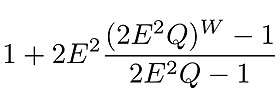 So basically O(E^2W * Q^W). In the case where W = 15, E = 10, and Q = 0.1, we have: 344,926,315,789,473,684,201 = 344,926 * 316 trillion In the case where W = 15, E = 10, and Q = 0.01, we have: 6,553,401 In the case where W = 15, E = 10, and Q = 1/150, we have: 44,175 In the case where W = 7, E = 10, and Q = 0.01, we have: 25,401 In the case where W = 7, E = 10, and Q = 1/150, we have: 3,892 Discussion In practice, the algorithm's search tree appears to be much, much smaller than this, so perhaps Q can't be modeled as a constant. The other important consideration is that Unique APP avoids branching to fragments it has already searched, which heavily prunes the tree. |
