This section lists all blog posts, regardless of topic.
Nuance = Nuisance
December 15, 2008

After reading David Pogue's very positive review of Dragon Naturally Speaking 10, I figured I'd check it out and see if there was an SDK to play with. There was mention of an SDK on their web site, but strangely no download link, only a link to send a sales request.
I couldn't believe the response: It costs $5000 to download their SDK, or if you just want to take it for a spin, an evaluation costs $2500. What a joke!
Maybe I'm missing something, but it seems like Nuance doesn't understand why SDKs are something you give away: So that developers will create systems that use your product, thus driving sales. A did a bit of Googling and found other people scratching their heads.
I looked up the company's stock and it lost 65% of it's value between May and November.
|
 |
BlackBerry Bold
December 5, 2008
After work today Meredith showed off her new BlackBerry Bold, and am I ever impressed. It has only been in the last year or so that the BlackBerry has really grabbed my attention: They've improved to the point that they are extremely attractive, versatile devices.
The Bold's screen is fantastic. I'm blown away by the resolution of these new displays, and on-screen fonts are extremely crisp and well proportioned. In addition to the great screen, I love how the overall look of the screen and upper portion is flat and glossy.
After playing with the music player, video player, and camera, I am reminded by the amazing convergence that is happening and will continue to happen. We're now at the point of combining telephone, email, web search, maps, music, video, camera, calendar + tasks, GPS, voice notes, ... wow. Incredible.
It occurred to me this week that the BlackBerry and iPhone represent great AI devices. I guess Google's voice search hints at this, but I'm thinking more directly about what I've been working on. Imagine wearing a wireless earbud and a wireless lapel microphone. The BlackBerry/iPhone would interpret speech and relay responses to user via the earbud.
The amazing thing is that it would be as if the whole of the Internet were inside your head. You could be anywhere at any time and ask almost any question and get an answer "inside your head".
|
 |
Exercise 40: Mathematical analysis of the Adjacent Pair Permutation methodDecember 2, 2008
SummaryThe APP algorithm processes each each pair permutation. Each pair permutation forms a search tree. Perform an analysis on the number of nodes in a typical pair permutation tree given that:
  | There are W words |
| There are E entity types per word |
| The fraction of pair permutations that transform is Q |
SolutionI wasn't quite sure how to solve this one, so I called on Mr. Vaughn Climenhaga for some help, and he delivered! Thanks Vaughn!
The following solution assumes that only the first two pair permutations are considered, which is a best-case scenario. (I'm unclear on whether the algorithm is feasible with this limitation)
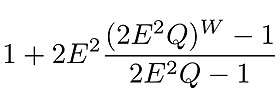
So basically O(E^2W * Q^W).
In the case where W = 15, E = 10, and Q = 0.1, we have:
344,926,315,789,473,684,201 = 344,926 * 316 trillion
In the case where W = 15, E = 10, and Q = 0.01, we have:
6,553,401
In the case where W = 15, E = 10, and Q = 1/150, we have:
44,175
In the case where W = 7, E = 10, and Q = 0.01, we have:
25,401
In the case where W = 7, E = 10, and Q = 1/150, we have:
3,892
DiscussionIn practice, the algorithm's search tree appears to be much, much smaller than this, so perhaps Q can't be modeled as a constant.
The other important consideration is that Unique APP avoids branching to fragments it has already searched, which heavily prunes the tree.
older >>
