The is_a relationshipJuly 9, 2008
Perhaps the most fundamental relationship is the
is_a relationship. Some examples:
This directional relationship can be used in two different contexts:
1. | To indicate that one general concept builds upon another. ex. (grass) (is_a) (plant) |
| 2. | To indicate that a specific object in the world is of a certain type. ex. (Daniel) (is_a) (person) |
The difference here is that (grass) is a general concept whereas (Daniel) is a real thing.
Has AI delivered?July 8, 2008
Here's a
good article that talks about the lofty promises of AI, which go back as far as the 50s, and have yet to materialize. The article also gives some examples of recent AI successes. One of summary points is that the classical definition of AI isn't where most of the progress is being made. Rather, it is in specialized system.
A rather astonishing figure is that Microsoft Research employs nearly 1,000 PhDs that are actively working in the field of AI. Wow. That's about a factor of 10 larger than I would have guessed.
Encoding a relationship using nodes and edgesJuly 8, 2008
A relationship consists of three things: Two entities and their relation:
| (entity1) (relation) (entity2) |
|
An ambiguous relationship between two entities can be modeled using nodes and edges as follows:
This is a binary relationship, but what we're really after is a three way, directed relationship. For example, "Daniel likes software":
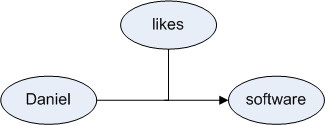
This solves the problem of encoding the information, but we're already rubbing up against our desire to stick to only a directed graph representation, which don't include directed ternary edges. We'll let this slide for the moment.
older >>
